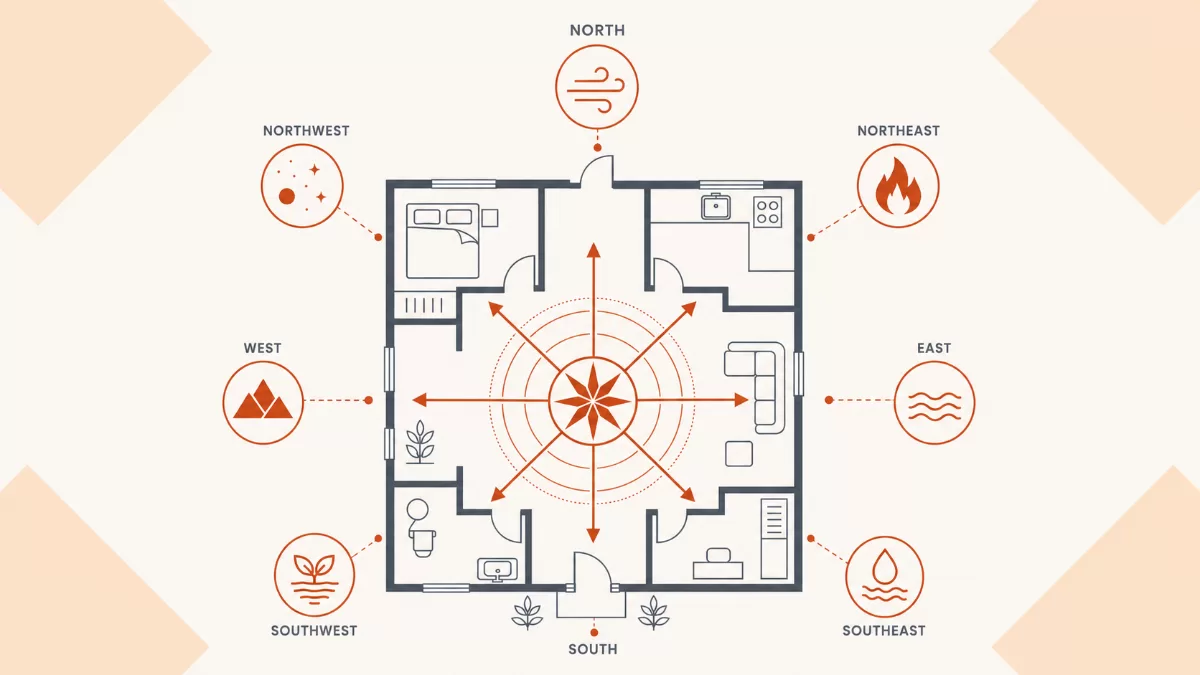
In consultation practice, one often encounters living spaces that feel perpetually tense, restless, or stagnant despite luxurious interiors. In Vedic wisdom, space is not an empty vacuum; it is a vibrating field of subtle energy. Vastu Shastra is the ancient Indian science of spatial architecture that aligns physical structures with cosmic, solar, and magnetic forces to nurture health, prosperity, and peace of mind.
💡 Think of Vastu as acupuncture for your physical environment. When the energetic meridians of your living space align with natural laws, life flows with minimal resistance.
The Origins: Who Founded Vastu Shastra?
Unlike modern architectural systems attributed to individual designers, Vastu Shastra originated within the Vedic scriptures, documented extensively in classical texts such as the Matsya Purana, Agni Purana, Manasara, and Brihat Samhita.
Classical tradition attributes the foundational principles of Vastu to two divine architects:
- Vishwakarma: The divine architect of the Gods, credited with northern and classical royal architecture.
- Maya Danava (Mayan): The legendary master builder credited with Southern Dravidian Vastu traditions (Mayamata).
🏛️ The Legend of Vastu Purusha
Philosophically, the science is anchored in the cosmic legend of Vastu Purusha—the personification of cosmic energy who lies pressed to the earth face down, with his head in the Northeast (Ishanya) and his feet in the Southwest (Nairrutya). Designing a home means respecting the anatomy of this living cosmic presence.
The 5 Core Pillars: The Pancha Mahabhutas
Every living space operates through the interplay of the five great elemental energies (Pancha Mahabhutas). Proper Vastu balances these five forces inside your walls:
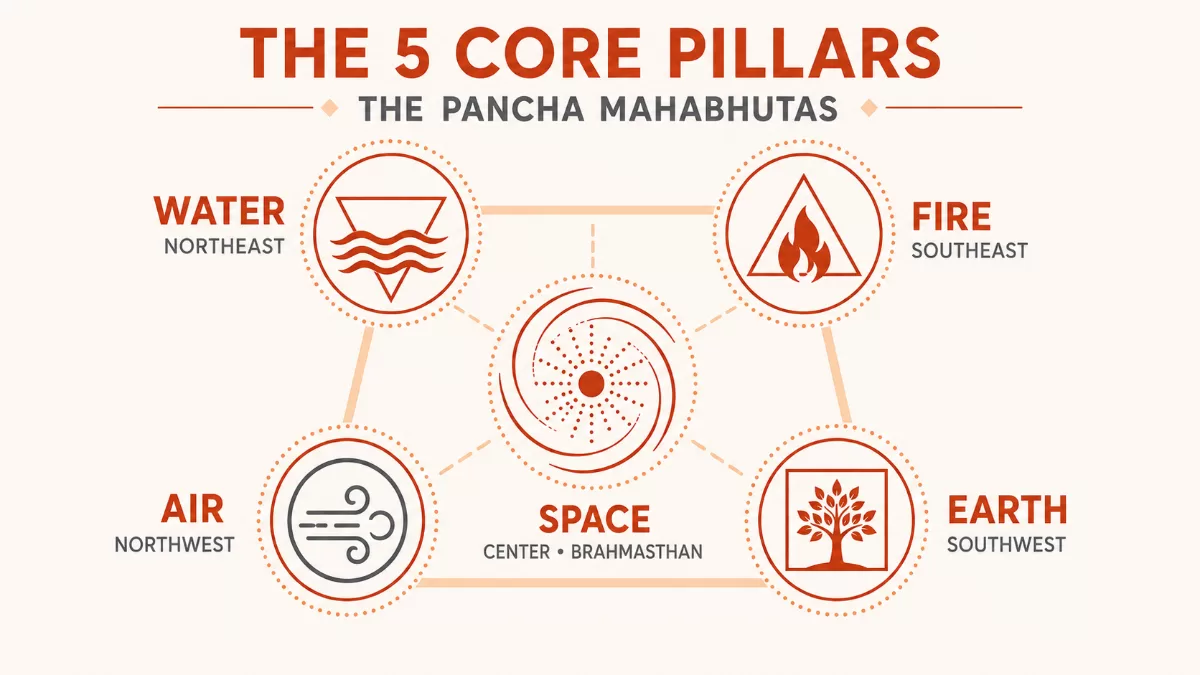
💧 Water (Jal)
Represents fluidity, clarity, and wealth accumulation. Dominates the Northeast.
🔥 Fire (Agni)
Represents vitality, digestive power, and cash flow. Dominates the Southeast.
🌱 Earth (Prithvi)
Represents stability, grounding, and physical weight. Dominates the Southwest.
💨 Air (Vayu)
Represents movement, social connections, and relationships. Dominates the Northwest.
🌌 Space (Akasha)
Represents expansion and consciousness. Governs the open central zone (Brahmasthan).
Significance of the 8 Directions (Quick Guide)
Each direction carries a specific magnetic polarity, planetary ruler, and energetic signature:
| Direction & Zone | Ruler & Element | Ideal Placement | What to Avoid |
|---|---|---|---|
| 1. North (Uttara) Kubera Zone |
Mercury & Lord Kubera | Living areas, home offices, open light spaces | Heavy storage, master bedrooms, overhead water tanks |
| 2. North-East (Ishanya) Devata Zone |
Jupiter & Water Element | Puja Mandir, meditation room, clear water bodies | Toilets, kitchens, staircases, heavy clutter |
| 3. East (Purva) Indra Zone |
Sun (Surya) | Large windows, main entrances, open balconies | Tall boundary walls, heavy wardrobes blocking sunlight |
| 4. South-East (Agneya) Fire Zone |
Venus (Shukra) & Fire | Main kitchen cooktop, electrical panels, meters | Water sinks next to stove, bedrooms, borewells |
| 5. South (Dakshina) Yama Zone |
Mars (Mangal) | Thick heavy walls, secondary bedrooms, storage | Main building entrances, large water bodies, borewells |
| 6. South-West (Nairrutya) Ancestral Earth Zone |
Rahu & Earth Element | Master bedroom, household head workspace | Entrances, toilets, underground water tanks |
| 7. West (Pashchima) Varuna Zone |
Saturn (Shani) | Study desks, dining space, overhead water tanks | Low open boundaries, sunken floor levels vs East |
| 8. North-West (Vayavya) Wind Zone |
Moon (Chandra) & Air | Guest bedrooms, parking, finished sales goods | Master bedrooms (causes chronic restlessness) |
Practical Living with Vastu
Vastu Shastra is not about rigid superstition or knocking down walls. It is about intentional spatial alignment. By keeping the Northeast light, the Southwest heavy, and honoring the central Brahmasthan with open breathing room, you establish an environment where physical health and psychological peace can truly thrive.
🌿 Summary takeaway: Aligning your living environment with natural magnetic and solar axes reduces subtle environmental friction, fostering mental clarity, restful sleep, and steady prosperity for all occupants.