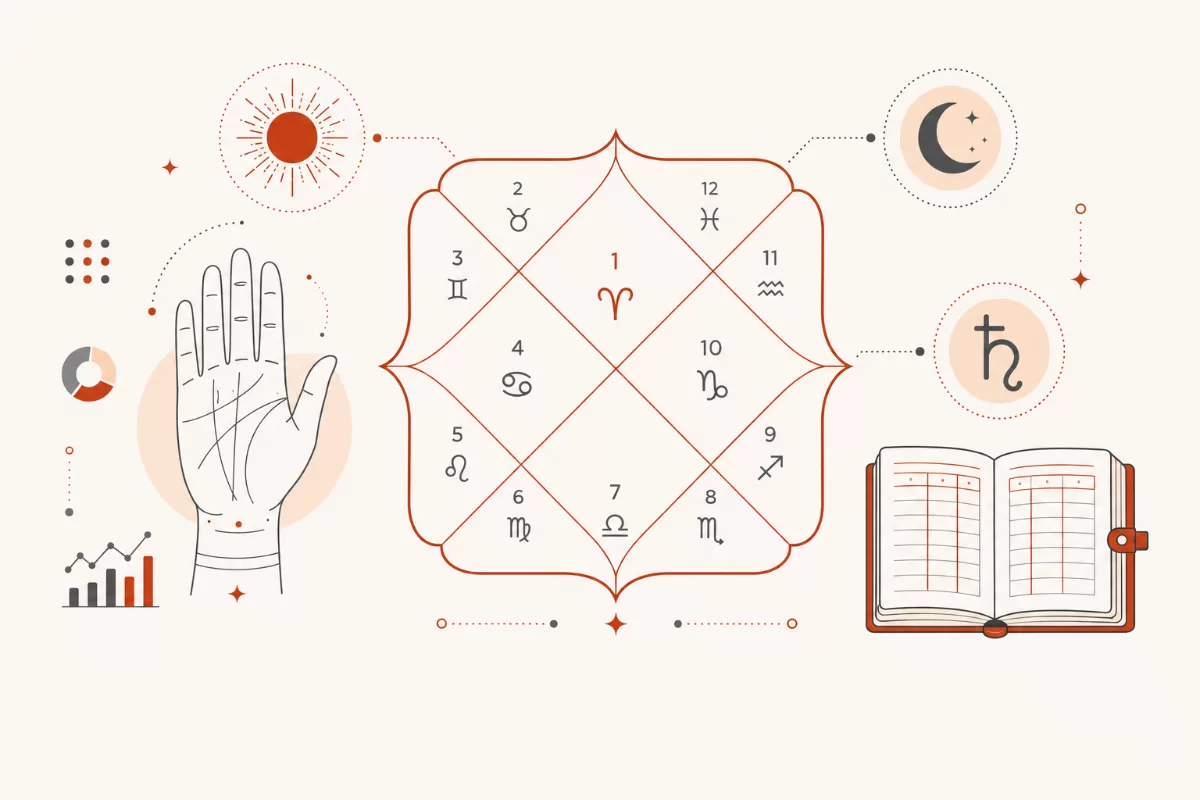
For millennia, classical Vedic astrology (Parashari and Jaimini systems) has stood as the gold standard of cosmic analysis. With its sophisticated mathematical frameworks, sixteen divisional charts (Shodashvarga), and intricate planetary periods (Dashas), Vedic astrology charts the complete blueprint of human destiny.
Yet, during the mid-20th century, a distinct, poetic, and remarkably pragmatic branch of astrology emerged across Northern India that quickly captured widespread devotion: Lal Kitab (The Red Book).
📕 The Red Ledger of Karma: Named after traditional Indian merchant ledgers (bahi-khata) bound in red cloth, Lal Kitab serves as a spiritual and practical audit of one’s active karmic debts (Rina).
The Origins and History of Lal Kitab
The roots of Lal Kitab lie in pre-independence Punjab. Published between 1939 and 1952 in five successive treatises, the system was originally written in poetic Urdu interspersed with Punjabi and Persian aphorisms.
The revered architect of this system was Pandit Roop Chand Joshi (1898–1954), a scholar and accounts officer in the British Indian defense establishment from the village of Pharwala (Jalandhar, Punjab). Rather than claiming prophetic authorship, Pt. Joshi presented these works as a synthesis of ancient Samudrika Shastra (the science of body traits and palmistry), folk traditions, and Persian-Vedic astrological principles.
The Five Original Volumes
- 1939: Lal Kitab Ke Farman (The Decrees of Lal Kitab)
- 1940: Lal Kitab Ke Arman (The Aspirations of Lal Kitab)
- 1941: Gutka (Pocket Compendium)
- 1942: Lal Kitab Tarmeem Shuda (The Revised Edition)
- 1952: Ilm-e-Samudrik Ki Lal Kitab (The Definitive Compendium of Palmistry & Astrology)
Why Lal Kitab Grew Popular Alongside Deep Vedic Methods
Vedic astrology provides unmatched philosophical depth, but it historically presented steep practical barriers for everyday individuals seeking urgent solutions. Lal Kitab gained rapid popularity because it turned complex planetary diagnostics into actionable, household remedies.
1. The Fixed Natural Chart (Kalpurush Kundli)
Unlike Vedic astrology, where the first house changes based on the exact rising ascendant degree, Lal Kitab treats House 1 as permanently ruled by Aries (Mars), House 2 by Taurus (Venus), and so forth. This fixed structure simplifies house-to-planet interactions, focusing directly on the nature of the house (Pakka Ghar) without requiring intricate divisional chart calculations.
2. Diagnosis Through Palmistry and Household Signs
Lal Kitab directly links the birth chart with palmistry (Hastarekha) and physical surroundings. If a person lacks an accurate birth time, an astrologer can identify a malefic Rahu simply by noticing damaged drainage lines in the home, sudden electrical failures, or specific markings on the palm.
3. Inexpensive and Accessible Remedies (Upayas)
Classical Vedic remedies often demand expensive gemstones, elaborate Sanskrit recitations, or multi-day temple rituals (Yagyas). Lal Kitab introduced simple, symbolic, and affordable remedies:
- Feeding stray dogs for a troubled Ketu
- Immersing copper coins in flowing water for an afflicted Sun
- Offering raw milk to roots of a Banyan tree for Moon-related peace
4. Focus on Behavioral Precautions (Parhez)
Lal Kitab places equal weight on preventive conduct. It teaches that certain actions trigger dormant planetary afflictions—such as never accepting free gifts when Saturn is compromised, or avoiding alcohol to protect an afflicted Jupiter.
Renowned Scholars and Masters of Lal Kitab
Several dedicated scholars preserved and decoded these cryptic Urdu verses for contemporary practitioners:
- Pandit Roop Chand Joshi: The visionary compiler and master astrologer whose selfless documentation created the entire foundation of modern Lal Kitab astrology.
- Pandit Beni Madhav Goswami: A scholarly authority who transliterated and translated the archaic Urdu and Persian verses into Hindi, safeguarding the original meanings for the modern era.
- Pandit Krishna Ashant: A veteran astrological author whose detailed commentaries systematically demystified the esoteric metaphors and grammatical structures of the 1952 edition.
- Pandit Umesh Sharma: A prominent modern master who standardized diagnostic techniques and championed structured, rule-based Lal Kitab remedy frameworks for international students.
✨ Summary: Lal Kitab is not a replacement for classical Vedic astrology; rather, it functions as an urgent, compassionate first-aid kit. When deep Vedic analysis identifies the karmic root of a challenge, Lal Kitab provides the accessible, day-to-day tools to restore energetic balance.