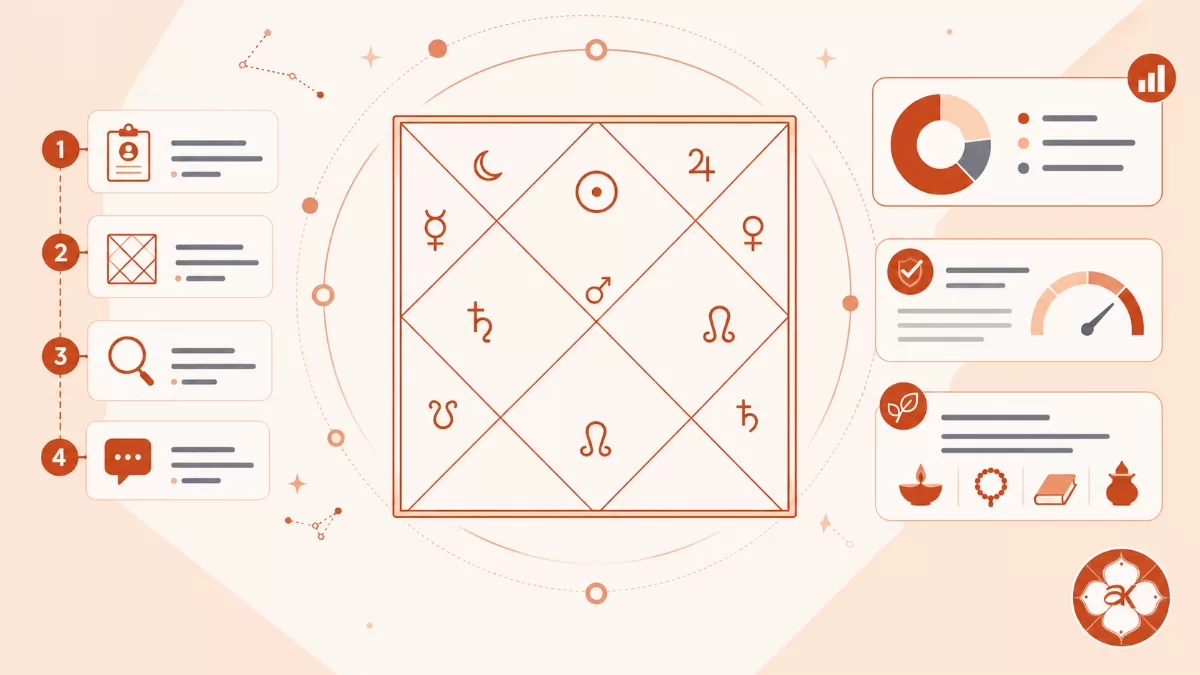
Lal Kitab may appear simple because its predictions are direct and its remedies use everyday objects. However, a new astrologer must first understand its house-based interpretation system before recommending any remedy. This guide explains a practical and responsible method for reading a Lal Kitab horoscope.
What is Lal Kitab Astrology?
Lal Kitab is a distinct branch of astrology codified in five Persian-Urdu treatises between 1939 and 1952. While rooted in Indian astrological principles, it focuses on karmic debts, observable psychological habits, and practical domestic remedies. Its primary goal is not fatalistic prediction, but the diagnostic repair of energetic blockages in daily life.
How It Differs from Traditional Vedic Astrology
In Parashari Vedic astrology, the rising sign (Lagna) determines the sign layout of the chart. Lal Kitab operates on a fundamentally different framework:
- The Kalpurush Blueprint: The Lal Kitab chart (Kundli) fixes Aries (Mesha) permanently in the 1st House. House 1 always represents Mars/Sun energy, House 2 Jupiter/Venus, House 3 Mars/Mercury, continuing sequentially through House 12 (Jupiter/Rahu).
- Rashi vs. House: Planetary placements are interpreted strictly through their house positions rather than dynamic zodiac sign placements.
- No Complex Calculations: Nakshatra divisions, divisional charts (vargas), and dasha periods like Vimshottari are replaced by a system of 35-year planetary cycles, annual charts (Varshphal), and mutual house aspects (Drishti).
Why Houses are Central to Lal Kitab Interpretation
In Lal Kitab, each house is treated as a physical room in a house or a specific department of life. A planet sitting in a house takes on the qualities of that "room's owner" (Kayam Karta). Understanding the structural health of the 12 houses is essential before evaluating individual planetary strengths.
The 7-Step Method to Analyze a Lal Kitab Chart
-
Step 1: Note the Planets Placed in Each House
Map the natal positions directly into the 12 fixed houses. Identify which planets occupy their own permanent houses (Pakka Ghar) and which are sitting in conflicting environments. -
Step 2: Understand Planetary Friendships and Enmities
Lal Kitab defines relationships as natural friends, mutual enemies, and artificial partnerships (Masnui planets). For instance, when Sun and Saturn combine, they produce the disruptive effect of a malefic Venus. -
Step 3: Identify Sleeping, Awakened, and Afflicted Planets
- Sleeping Planet (Soya Grah): A planet that receives no aspects and has no active companion to trigger its energy. It remains dormant until activated by age cycles or transits.
- Awakened Planet (Jaga Hua Grah): A planet stimulated by a complementary planet in an aspected house.
- Afflicted Planet (Dharmi / Paapi): Assess whether a natural malefic behaves neutrally (Dharmi) or delivers obstructive results due to its placement.
-
Step 4: Check the Effect of Empty Houses
Empty houses (Soya Ghar) represent inactive departments of life. They require the activation of their permanent ruling planet to release stalled results. -
Step 5: Connect Planetary Combinations with Real-Life Events
Translate combinations into observable facts. For example, Rahu in the 5th house combined with an afflicted Jupiter often correlates with interruptions in formal education or sudden electrical faults near family study spaces. -
Step 6: Verify Observations Through Diagnostic Questioning
Never prescribe remedies based on visual chart analysis alone. Ask targeted behavioral questions:- "Do you experience sudden disruptions with electronic devices at home?"
- "Is there stagnant water or dampness on the southern wall of your house?"
-
Step 7: Recommend Simple and Safe Remedies
Select remedies that gently balance planetary energies without agitating opposing forces. Use accessible items like copper coins, brass vessels, raw milk, or silver squares.
Essential Precautions Before Prescribing a Remedy
Critical Lal Kitab Guidelines
- Check the 8th House First: Never initiate remedies during active transits of malefic planets through the 8th house without addressing foundational protection.
- Avoid Blank Placement of Dark Grains: Donating items related to Saturn or Rahu without verifying their house placement can strip a beneficial placement of its grounding power.
- Prescribe Behavioral Adjustments (Parhez): A material remedy fails if the client continues conflicting lifestyle habits. For example, donating green items while disrespecting sisters or daughters counteracts Mercury remedies.
Sample Horoscope Interpretation
Consider a chart with Jupiter in the 10th House and Saturn in the 4th House:
- Analysis: Jupiter (wisdom, expansion) sits in Saturn’s workplace house (10th), while Saturn (discipline, labor) sits in the house of domestic peace (4th).
- Observation: The native often faces delays in career recognition when acting overly idealistic.
- Practical Remedy & Parhez: Keep a small square piece of pure silver immersed in a brass pot of water at home; avoid building underground water storage under the center of the living area.
Common Mistakes Made by New Astrologers
- Applying Parashari aspects (like Jupiter's 5th and 9th drishti) to a Lal Kitab chart.
- Treating remedies as magical fixes instead of environmental and behavioral recalibrations.
- Prescribing multiple remedies simultaneously, making it impossible to track which adjustment produced results.
Beginner Consultation Checklist
- ☑ Chart mapped to the fixed 1st-House Aries grid
- ☑ Sleeping and awakened houses noted
- ☑ Masnui (artificial) planetary combinations evaluated
- ☑ Active symptoms verified with diagnostic client questions
- ☑ Behavioral precautions (Parhez) established
- ☑ Maximum 1–2 focused, safe remedies prescribed for 40 to 43 consecutive days
Master Responsible Lal Kitab Consultation
Consistent practice with diagnostic observation transforms Lal Kitab from a collection of folklore remedies into a precise, responsible astrological consultation framework. Explore more Lal Kitab articles and astrological tools on Astrokul.in.