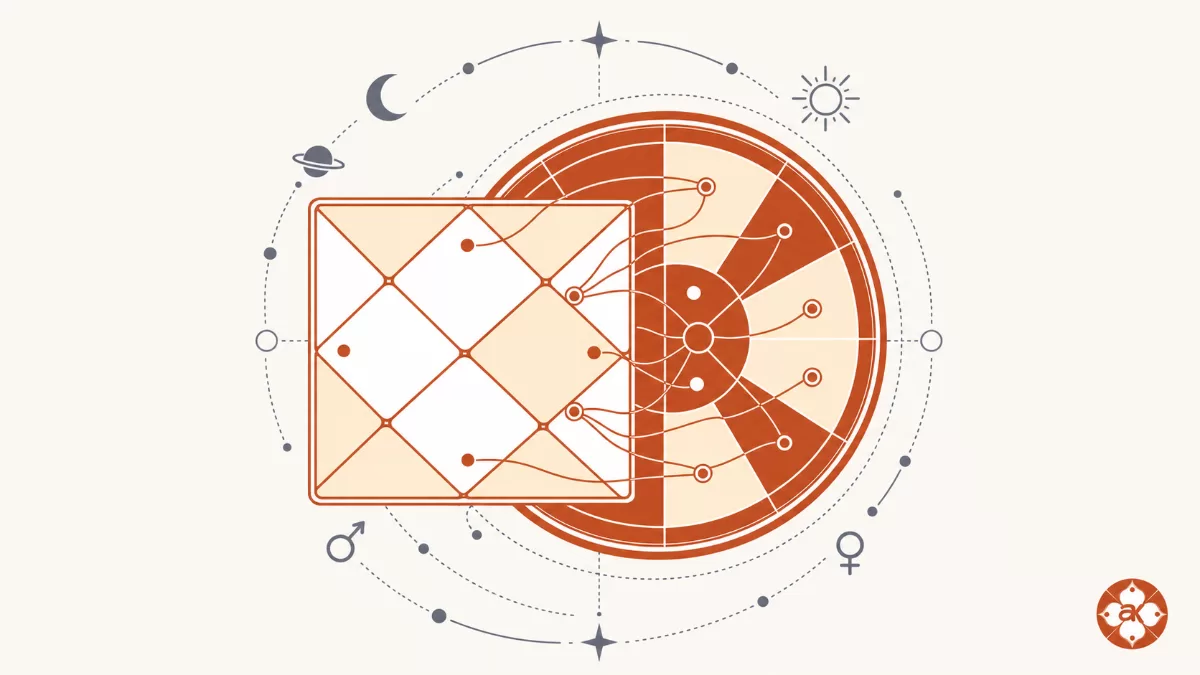
One of the most frequent missteps beginners make in Vedic astrology is opening the Navamsha (D9) chart and treating it as a separate, alternate birth chart. You might look at your Rashi chart (D1), see an exalted planet, and feel confident—only to glance at your D9, see the same planet in an enemy sign, and wonder which reality will manifest.
The answer is simple: you have only one birth chart.
The Navamsha is not a second life or an independent horoscope. It is a microscope placed directly over the D1. In classical Parashari Jyotish, the D1 represents the tree, while the D9 reveals whether that tree will bear sweet fruit or remain barren.
🔬 The Core Parashari Truth: The D1 is the physical seed and the outer tree; the D9 (Navamsha) is the taste, ripeness, and inner fruition of the fruit. You cannot harvest fruit without the tree, and a grand tree without fruit leaves you unfulfilled.
What the Navamsha Actually Measures
The word Navamsha translates to the "ninth division." Each zodiac sign of 30 degrees is divided into nine equal segments of 3 degrees and 20 minutes (3° 20').
Because the ninth house of any chart governs Dharma, grace, and fruition, the ninth harmonic division reveals the inherent righteousness and stamina of a planet.
The D1 (Rashi Chart)
Shows the physical manifestation, outer circumstances, social identity, and what is promised to you in the material world.
The D9 (Navamsha Chart)
Shows the internal potential, spiritual alignment, psychological stamina, and the final quality of that promise.
💼 The Career Analogy: Think of the D1 as the job offer letter you receive, and the D9 as your actual day-to-day capability to sustain that job over a twenty-year career.
The Core Rule: Layer Dignity, Do Not Re-read Houses
A common error is reading transits or life events solely from the D9 houses as if they exist in a vacuum. For example, reading the 4th house of the D9 to predict vehicle purchases often leads to erratic results.
Instead, use the D9 to assess Planetary Dignity and Real Strength:
1. Checking the "Real Muscle" of a Planet
If Jupiter sits in Cancer (exaltation) in your 10th house in D1, the world perceives you as wise, respected, and professionally fortunate.
However, inspect where that Jupiter falls in the D9:
- If Jupiter falls into Capricorn (debilitation) in the D9: The initial career opportunities look grand, but sustaining them takes enormous effort, and self-doubt creeps in during Jupiter's Dasha.
- If Jupiter is debilitated in D1 (Capricorn) but attains its exaltation sign (Cancer) in D9: This creates Neecha Bhanga on an internal level. The person struggles early on, builds humility, and achieves mastery and respect in the second half of life.
2. The Power of Vargottama
When a planet occupies the exact same zodiac sign in both the D1 and D9 charts, it is termed Vargottama.
This is one of the most stabilizing conditions in Jyotish. It means the outer circumstance (D1) and inner psychological intention (D9) are in complete harmony. A Vargottama planet rarely wavers under adverse transits because its core is unified.
3. Spotting Pushkara Navamsha
Certain specific arcs within the zodiac—known as Pushkara Navamshas—possess an innate ability to heal and nourish.
Even if a planet is placed in an uncomfortable dusthana house (6th, 8th, or 12th) in the D1, landing in a Pushkara Navamsha gives it the resilience to produce constructive outcomes after an initial trial.
Practical Consultation Insight: Why D9 Activates Over Time
You will often hear that the Navamsha "activates after marriage" or "after the age of 32 to 36."
Astrologically, this is not a sudden light switch. In youth, we run primarily on the physical and environmental momentum of the D1—our family background, inherited assets, and initial social conditioning.
⏳ The Maturation Arc: As we mature, enter partnerships, and take on dharmic responsibilities, our superficial conditioning wears off. What remains is our core psychological temperament—our Navamsha. Marriage accelerates this because living intimately with another person strips away external pretense, forcing the D9's planetary patterns to the surface.
How to Read D1 and D9 Together: A 3-Step Method
When analyzing any planet during a consultation, follow this sequence:
Locate the Promise (D1)
Note the planet’s house placement, lordship, and aspects in the Rashi chart. This tells you where the life theme manifests.
Verify the Substance (D9)
Look up that same planet in the Navamsha. Is its sign placement friendly, exalted, or compromised? This tells you how well the promise holds up under pressure.
Assess the D9 Lagna
Observe the rising sign of the D9. It highlights the underlying nature of your soul's current evolutionary direction, acting as the lens through which your life's higher purpose filters.
Never isolate the Navamsha from its source. Anchor your roots firmly in the D1, and use the D9 to see how deeply those roots can draw nourishment from within.
Analyse Your Navamsha & Divisional Charts on Astrokul
Generate your complete D1 Rashi Kundli alongside high-precision divisional charts (D9 Navamsha, D10 Dashamsha, D60 Shashtiamsha), calculate planetary dignities, Vargottama states, and Pushkara placements on Astrokul.in.