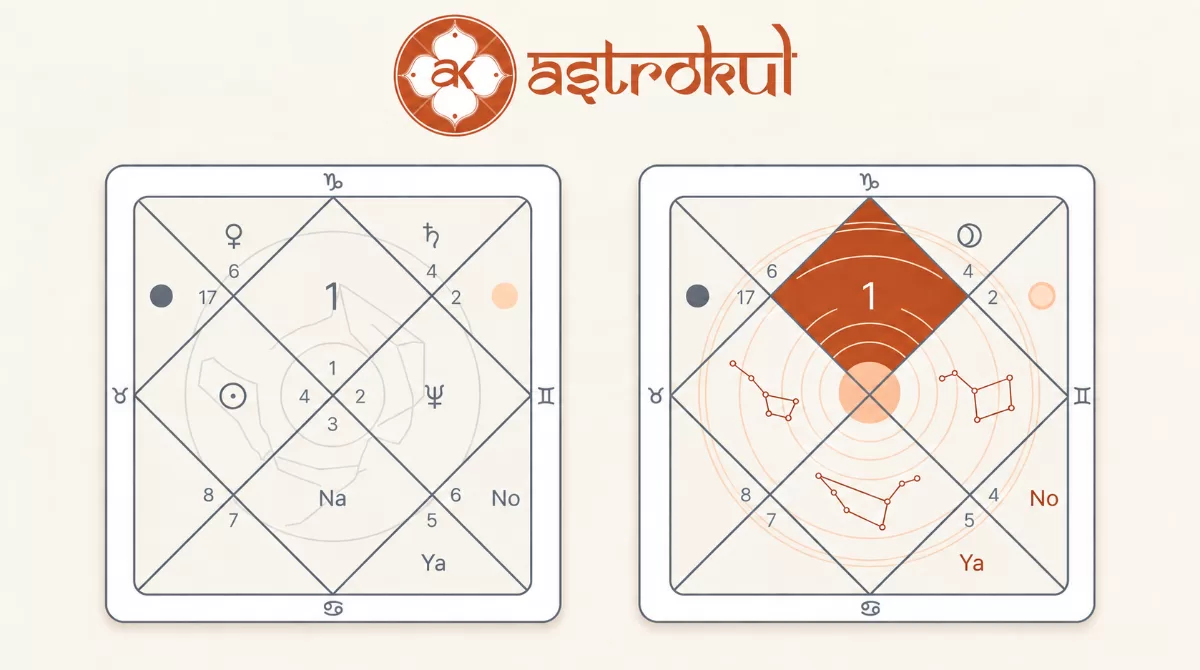
For a student trained in classical Parashari Vedic astrology, the first encounter with Lal Kitab can feel disorienting. You open a chart, look for the rising sign (Lagna), and expect the houses to rotate based on the exact moment of birth. Instead, Lal Kitab presents an unshakeable rule: The 1st House is always Aries, the 2nd House is always Taurus, and the 12th House is always Pisces.
This intentional design anchors the entire system. Shifting from a dynamic ascendant to the fixed Kalpurush Kundli (Cosmic Archetype Grid) requires adjusting how you evaluate planetary behavior, natural rulership, and remedies.
🧭 The Fundamental Paradigm Shift: Parashari asks, "Which zodiac sign is rising on the Eastern horizon?" while Lal Kitab asks, "Which permanent room of the Kalpurush is this planet inhabiting?"
The Core Concept: The Permanent Architecture of the Houses
In Parashari astrology, signs move through houses dynamically. If you are a Scorpio ascendant, Scorpio occupies your 1st house, Sagittarius rules your 2nd, and Mars governs your personal identity.
Lal Kitab dissolves this shifting frame. It views the twelve houses as permanent cosmic rooms with fixed owners (Khana Malik) and fixed significators (Karakas):
House 1 (Khana No. 1)
AriesPermanently owned by Mars (Mangal), with the Sun (Surya) as its eternal Karaka.
House 2 (Khana No. 2)
TaurusPermanently owned by Venus (Shukra), with Jupiter (Brihaspati) as its Karaka.
House 4 (Khana No. 4)
CancerPermanently owned by the Moon (Chandra), representing heart, mother, and mental tranquility.
House 10 (Khana No. 10)
CapricornPermanently owned by Saturn (Shani), embodying karma, endurance, and public duty.
When reading a chart through this framework, you are not erasing the native's planetary positions; you are placing those planets into the universal anatomy of time and space.
Dynamic Rising Horizon
"Which sign is rising on the Eastern horizon at the moment of birth?"
Fixed Cosmic Archetype
"Which room of the Kalpurush is this planet inhabiting?"
The Mental Shift: Separating the Room from the Tenant
To read Lal Kitab accurately, you must view each house as a furnished room and each planet as a visiting guest.
In classical astrology, a planet derives its strength primarily through sign placements—exaltation (Uccha), debilitation (Neecha), or friendly signs (Mitra Rashi). In Lal Kitab, a planet's behavior depends heavily on how comfortable it is in the specific room it occupies, regardless of the sign it carried at birth:
- The Room Owner (Malik): The planet that naturally rules that Kalpurush house (e.g., Mars for House 1, Venus for House 2).
- The Sitter (Mukaam): The planet currently placed in that house in the native's chart.
- The Karaka: The cosmic energy naturally awakened within that specific department of life.
Jupiter Placed in the 10th House
Consider Jupiter placed in the 10th house. In Parashari, if the 10th house holds Cancer, Jupiter is exalted and assumed to deliver unmitigated professional glory, spiritual reverence, and effortless prestige.
Lal Kitab views this differently: The 10th house is the natural domain of Saturn (Shani) and the exaltation ground of Mars (Mangal). Jupiter here enters dry, structured, hard-working soil. The system labels this position as a "cunning or worldly Jupiter" (Fakir / Chalaak Guru). The spiritual planet must adapt to the practical, gritty realities of Saturn's office. The house conditions the planet far more than the original zodiac sign does.
Practical Rules for Parashari Astrologers
When translating a traditional natal chart into Lal Kitab's fixed grid, apply these diagnostic fundamentals:
Ignore Changing Ascendant Numbers
Do not draw houses based on the rising sign degree. Take the planets exactly where they sit by house number in the Lagna chart and drop them directly into the 1-to-12 Kalpurush template. If Mars is in your 4th house in your Parashari chart, it is analyzed directly in Khana No. 4 in Lal Kitab.
Identify "Pakka Ghar" (Permanent Seats)
Every planet has a permanent house where its core nature thrives without obstruction:
Observe the Dual Ruler Dynamic
When analyzing any placement, synthesize two fundamental layers:
- The inherent nature of the planet occupying the house.
- The natural ruler of that house in the Kalpurush sequence.
For example, placing the Sun in the 2nd house means putting royal, fiery solar energy into Taurus's vault—a domain ruled by Venus and watched over by Jupiter. The native's speech, wealth, and family legacy will directly reflect the friction or harmony between the Sun, Venus, and Jupiter.
The Behavioral Insight (Parhez)
Lal Kitab is fundamentally an astrology of conduct and environmental harmony. The fixed grid exists so you can identify which natural laws are being disrupted.
🛡️ Conduct as the Ultimate Remedy: When your 1st house is treated permanently as Aries, your personal agency and physical vitality are tied to the righteous, disciplined use of Mars energy. Indulging in anger, neglecting physical action, or disrespecting elders directly damages the foundational pillar of the entire chart.
By anchoring your analysis to the Kalpurush grid, you stop getting tangled in shifting house dignities and clearly read the functional mechanics of the native's life.
Master Lal Kitab Horoscopy with Astrokul
Generate your complete Lal Kitab Kundli, analyze sleeping and awakened planets (Soya/Jaaga Grah), calculate Masnui combinations, and access customized Lal Kitab Parhez & Upay on Astrokul.in.