In our fast-paced modern world, we obsessively check weather forecasts, market trackers, and calendar alerts before making a move. Yet, we often overlook the subtle energetic forecast shaping our mental clarity and operational success: the daily cosmic environment.
For over 15 years in active consultation, I have guided clients who felt their best-laid plans derailed by friction they could not explain. The remedy was rarely a complex ritual; it was simply learning to align actions with the natural currents of time. A daily Panchang is not an outdated almanac—it is your practical cosmic GPS for daily living.
What is a Panchang?
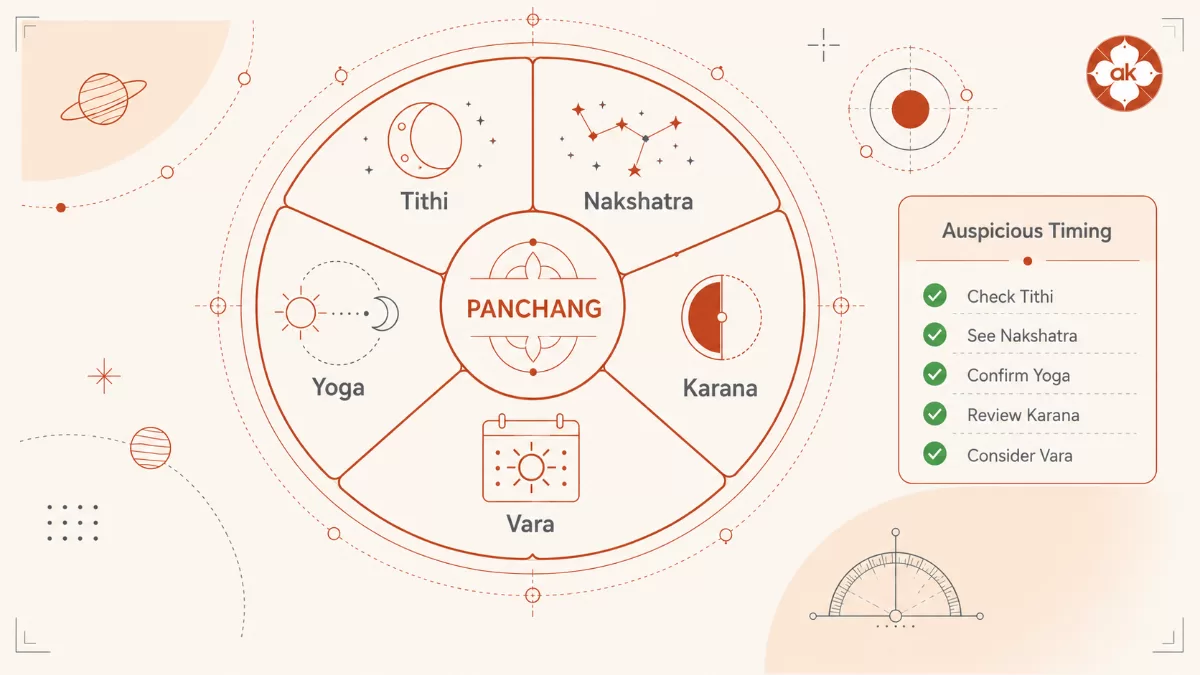
The word Panchang originates from two Sanskrit terms: Panch (five) and Anga (limbs). It represents the five fundamental attributes of time derived from the precise mathematical and astronomical relationship between the Sun (representing our soul and vitality) and the Moon (governing our mind and emotional state).
Just as a physical body requires balanced limbs to move effectively, time carries five energetic dimensions that define whether an action will meet resistance or effortless momentum.
How to Read a Daily Panchang: The 5 Cosmic Pillars
To read a Panchang confidently, you must understand how its five pillars work in synergy:
- 1. Vara (Solar Day): The day of the week, ruled by a specific planetary archetype that sets the baseline vitality. Sunday (Sun) supports authority and health; Monday (Moon) favors emotional connections; Tuesday (Mars) aids decisive physical execution; Wednesday (Mercury) powers commerce and logic; Thursday (Jupiter) amplifies learning and expansion; Friday (Venus) boosts creative and relational pursuits; and Saturday (Saturn) favors discipline, auditing, and structural foundation.
- 2. Tithi (Lunar Day): Calculated by every 12-degree separation between the Sun and the Moon. A lunar month contains 30 Tithis split across two fortnights: Shukla Paksha (waxing phase, ideal for initiating growth) and Krishna Paksha (waning phase, suited for introspection, resolution, and winding down).
- 3. Nakshatra (Lunar Mansion): The specific constellation the Moon transits on a given day (out of 27). The Nakshatra provides the practical "flavor" of daily execution. For instance, fixed Nakshatras like Rohini favor long-term contracts, while movable ones like Ashwini favor travel and rapid rollouts.
- 4. Yoga (Solar-Lunar Conjunction): Formed by the combined longitudes of the Sun and Moon, producing 27 distinct energetic qualities. Yogas indicate the ambient harmony of the day—auspicious Yogas like Siddhi or Amrita facilitate smooth agreements, while challenging Yogas like Vyakaghaata warn against entering sensitive negotiations.
- 5. Karana (Half-Tithi): Half of a lunar day (two Karanas per Tithi). Karana dictates the best execution style. Mobile Karanas like Bava and Kaulava favor proactive work, whereas the fixed Karana Vishti (Bhadra) calls for pauses in major commercial launches.
Key Daily Windows: Sunrise, Sunset, Rahu Kaal & Abhijit Muhurat
A Vedic day does not begin at midnight; it begins precisely at local Sunrise and ends at the following sunrise.
Rahu Kaal
A daily 90-minute window ruled by Rahu’s chaotic influence. Avoid signing major financial deeds, initiating fresh ventures, or holding critical conflict resolutions during this span.
Abhijit Muhurat
A potent mid-day window (roughly 24 minutes before and after local astronomical noon). It carries the unique blessing of overcoming minor structural blemishes in the daily chart, making it an excellent universal window for urgent, important tasks.
Why Geographic Location Matters
A Panchang is never one-size-fits-all. Because its calculations hinge entirely on your local Sunrise, Sunset, and coordinates, a Tithi or Rahu Kaal active at 10:00 AM in New Delhi will not match the exact timing in London or New York. Always calibrate your Panchang to your exact city to ensure your Muhurat windows are mathematically precise.
Everyday Application & Common Interpretation Pitfalls
You do not need to overhaul your entire life to benefit from a Panchang. Start simply:
- Use the Vara to schedule aligned weekly meetings (e.g., business strategy on Wednesday).
- Check Rahu Kaal before finalizing key payments or submitting crucial paperwork.
- Aim for Shukla Paksha when launching visible community or brand initiatives.
The biggest mistake beginners make is falling into analysis paralysis by demanding a "100% flawless day." Absolute perfection does not exist in nature. Instead, look for overall harmony: if your Nakshatra and daytime window (like Abhijit) are strong, proceed with clear intention.
Partner with Cosmic Timing
When you understand the five limbs of time, you stop fighting the tide and start sailing with it. Explore daily coordinates and customized Muhurat tools on Astrokul.in to begin making aligned, confident decisions every single day.