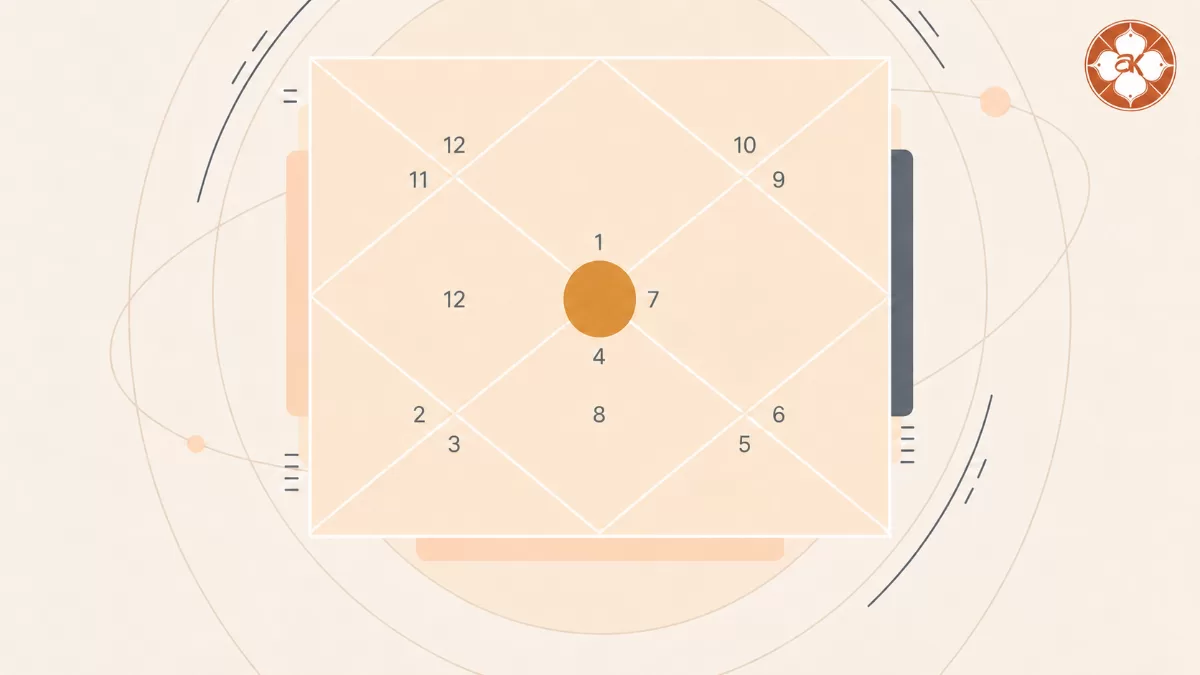
When students and practitioners transition from classical Parashari Jyotish to Lal Kitab, the first rule that triggers genuine shock is this: zodiac signs (Rashis) take a back seat, while house positions (Khanas) decide everything.
In traditional Vedic astrology, your planet’s power and dignity depend almost entirely on its zodiac sign. If your Jupiter sits in Cancer, you celebrate its exaltation (Uchcha). If Saturn sits in Aries, you brace for debilitation (Neecha).
Lal Kitab views your birth chart through a radically different lens. It fixes the 12 houses permanently to the natural Kalpurush Kundli (where House 1 is always Aries, House 2 is Taurus, and so forth through Pisces in House 12). Regardless of whichever ascendant sign was rising on the eastern horizon at your birth, the house number itself dictates planetary behavior, inherent dignity, and practical remedy pathways.
💡 The Lal Kitab Paradigm Shift: Signs describe subtle psychological texture, but houses govern your tangible physical reality—your living environment, material wealth, family lineage, and karmic debts.
The Concept of Fixed Rooms: The Landlord, The Decor, and The Tenant
To grasp why Lal Kitab assigns supreme priority to houses, consider a practical analogy commonly used in seasoned astrological consultations:
🏠 The House (Khana)
A permanent, physical room with non-negotiable architectural rules, foundational energetic atmosphere, and a permanent ruler (Pakka Ghar Malik).
🎨 The Zodiac Sign (Rashi)
The temporary wallpaper, styling, or clothing of that room. It provides subtle aesthetic flavor, but cannot alter the load-bearing pillars of the room.
🪐 The Planet (Graha)
The tenant living in the room. A tenant brings personal character, but must abide strictly by the landlord’s house regulations or suffer friction.
A tenant might bring their own personality, but they cannot demolish the load-bearing walls or rewrite the bylaws of the building. If you place the Sun—the natural emperor—into the 1st House, it sits on the throne. In Lal Kitab, the Sun is exalted in the 1st House by default, regardless of whether the sign written in your classical natal chart is Libra, Taurus, or Aries.
Pakka Ghar: The Universal Foundation of Planetary Dignity
In Lal Kitab, every planet has designated Pakka Ghar (permanent residences) where its essential vitality and core cosmic nature thrive unhindered. Because these assignments remain constant across all horoscopes, planetary strength is evaluated directly against the room occupied:
| House (Khana) | Kalpurush Sign Archetype | Pakka Ghar Planet (Lord) | Governed Life Arena |
|---|---|---|---|
| 1st House | Aries (Mesh) | Sun | Self, vitality, physical head, natural authority & dignity |
| 2nd House | Taurus (Vrishabh) | Jupiter | Accumulated wealth, family treasury, speech & ancestral dharma |
| 3rd House | Gemini (Mithun) | Mars | Courage, younger siblings, raw initiative & physical drive |
| 4th House | Cancer (Kark) | Moon | Mother, domestic peace, home environment, vehicles & emotional mind |
| 5th House | Leo (Simha) | Jupiter | Intellect, children (offspring), higher wisdom & past-life merits |
| 6th House | Virgo (Kanya) | Mercury & Ketu | Debts, illnesses, maternal uncle, hidden competitors & daily duty |
| 7th House | Libra (Tula) | Venus & Mercury | Marriage, spouse, business partnerships & daily marketplace commerce |
| 8th House | Scorpio (Vrishchik) | Mars & Saturn | Longevity, sudden upheavals, hidden karma & death transitions |
| 9th House | Sagittarius (Dhanu) | Jupiter | Dharma, divine grace, higher fortunes, father & elders’ blessings |
| 10th House | Capricorn (Makar) | Saturn | Profession, public authority, worldly standing & active karma |
| 11th House | Aquarius (Kumbh) | Saturn | Recurring profits, network circles, elder siblings & realized ambitions |
| 12th House | Pisces (Meen) | Jupiter & Rahu | Expenditures, foreign settlements, bedroom pleasures & spiritual moksha |
Consider Venus: in classical Vedic astrology, Venus is considered debilitated when placed in Virgo. But in Lal Kitab, if Venus occupies the 12th House, it is considered exalted by house position, bestowing luxurious comforts, marital harmony, and foreign prosperity—completely overriding the fear of sign debilitation.
Why "Exalted" Planets Fail in Real Life
One of the most frequent dilemmas clients bring to consultations is this:
"Guruji, my Jupiter is exalted in Cancer in the 10th House, yet my professional career feels completely stagnant and fraught with bureaucratic roadblocks. Why isn't my exalted planet delivering success?"
Classical Parashari astrology looks at Cancer and celebrates the exalted status. But Lal Kitab inspects the room:
- The 10th House belongs permanently to Saturn.
- Jupiter entering the 10th House is akin to a gentle, ascetic guru stepping into the cold, strict, transactional courtroom of Saturn.
- In Lal Kitab, Jupiter in House 10 is classified as Manda (depressed/afflicted). The expansive, idealistic, and dharmic nature of Jupiter struggles against the harsh, mechanical accountability required by the 10th room.
This house-first diagnostic explains real-world friction and roadblocks that purely sign-based astrological readings routinely overlook.
The Practical Advantage for Remedies (Upaye & Parhez)
The supremacy of houses is what makes Lal Kitab remedies so direct, tangible, and effective. Lal Kitab remedies do not seek to manipulate distant stellar constellations; they manipulate concrete physical elements directly tethered to house environments:
Pathway 1 Direct Environmental Correction
If an adverse planet resides in the 4th House (the house of water, home, and mother), remedies immediately involve pure water, silver, or restoring harmony with the maternal figure. You heal the room, and the planet immediately calms down.
Pathway 2 Behavioral Precautions (Parhez)
Lal Kitab places equal emphasis on Parhez (preventative conduct). For example, if Saturn sits in your 1st House, Lal Kitab strictly warns against constructing a home prematurely or engaging in falsehoods—because the 1st House (vitality and head) cannot support Saturn's heavy structural weight without eroding ancestral vitality.
Conclusion: Bringing Clarity Back to Your Chart
By anchoring its wisdom in fixed houses rather than shifting zodiac signs, Lal Kitab delivers grounded, logical insights that strip away confusing astrological jargon. It brings you straight to the heart of what is happening in your life—and provides practical, accessible remedies to restore equilibrium.
Discover Your Lal Kitab Kundli & Custom Remedies on Astrokul
Generate your complete 12-house Lal Kitab Varshphal, identify your active Pakka Ghar placements, detect karmic debts (Rina), and receive personalized behavioral precautions tailored to your birth chart on Astrokul Lal Kitab Astrology.