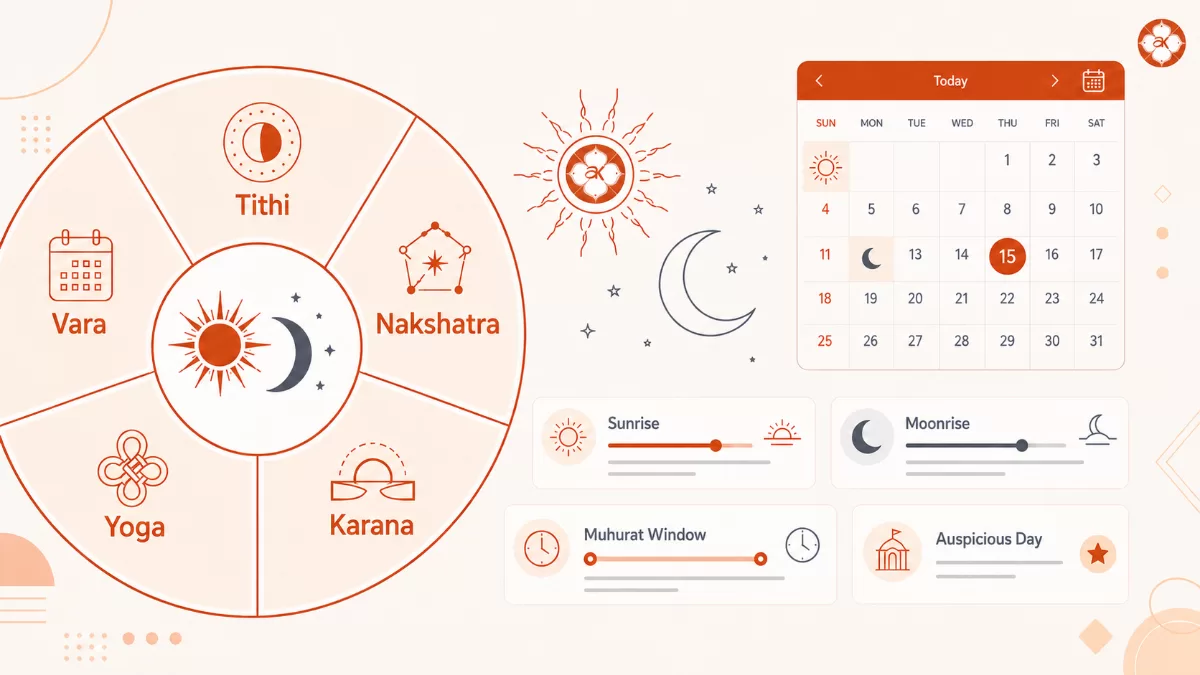
For centuries, traditional Indian households began their morning by consulting the Panchang—the Vedic almanac that maps the quality of time. Today, a quick search gives you instant access to "Today's Panchang" on your smartphone.
Yet, having data at your fingertips is not the same as knowing how to use it. Many people either get overwhelmed by complex Sanskrit terminology or misapply online timings, leading to unnecessary anxiety over daily decisions. Understanding the Panchang is simply about learning how the cosmic environment affects your energy, focus, and actions each day.
💡 Key Principle: Think of the Panchang as a cosmic weather report. It allows you to align your daily efforts with natural energy currents instead of fighting against unfavorable planetary tides.
The 5 Limbs of Panchang: Your Daily Energy Checklist
The word Panchang literally translates to "five limbs" (Pancha + Anga). Each limb represents a specific cosmic dynamic governed by the interplay of the Sun and the Moon:
1. Tithi (Lunar Day)
Governed by the Water element, Tithi influences your emotional state, relationships, psychological openness, and general mood.
2. Vara (Solar Weekday)
Governed by Fire, your weekday dictates physical stamina and vitality. Tuesdays reflect Mars (action), while Wednesdays reflect Mercury (intellect & trade).
3. Nakshatra (Lunar Mansion)
Governed by Air, the Moon’s transit through a Nakshatra determines where collective mental focus, desires, and subconscious impulses flow.
4. Yoga (Sun-Moon Angle)
Governed by Ether, Yoga indicates the subtle harmony, cosmic resonance, or friction present in the atmosphere throughout the day.
5. Karana (Half-Tithi)
Governed by Earth, Karana reveals your capacity to turn intentions into tangible, practical work and complete day-to-day execution.
What You Should Actually Check Before Starting Your Day
You do not need to analyze all five limbs for routine tasks. For practical daily planning, focus on these three primary checkpoints:
Checkpoint 1 The Active Nakshatra
Before scheduling important creative sessions, negotiations, or travel, check the reigning Nakshatra. For example, swift Nakshatras like Ashwini or Pushya support initiating critical work, while fierce Nakshatras like Ardra or Bharani are better suited for decluttering, deep research, or resolving overdue problems.
Checkpoint 2 Shubh Muhurats (Abhijit & Amrit Kaal)
If you need an auspicious window to sign a contract, launch a project, or make a major purchase, look for Abhijit Muhurat (occurring roughly around local solar noon) or the day's Amrit Kaal for smooth, auspicious execution.
Checkpoint 3 Inauspicious Windows (Rahu Kaal & Yamaganda)
Rahu Kaal lasts approximately 90 minutes each day. It is an unfavorable window for initiating brand-new ventures, formal agreements, or major financial commitments, though routine everyday chores remain completely unaffected.
3 Critical Mistakes People Make While Reading Panchang Online
Modern digital tools make checking the Panchang simple, but they also introduce common interpretative errors:
1. Ignoring Location-Based Sunrises
Panchang calculations depend entirely on local sunrise and sunset. If an app defaults to New Delhi or Ujjain while you are in London, New York, or Bengaluru, your Tithi end-times and Rahu Kaal windows will be incorrect. Always verify that your app uses your exact GPS coordinates.
2. Assuming a Tithi Lasts the Entire Day
Unlike the 24-hour Gregorian calendar day, a Tithi can begin and end at any point during the day or night. A day might start with Chaturthi at sunrise and transition into Panchami by 2:00 PM. Always check the exact start and end timestamps rather than assuming one energy dominates all 24 hours.
3. Treating Rahu Kaal as "Paralysis Time"
A common misconception is that all activity must pause during Rahu Kaal. Rahu Kaal applies specifically to initiating new, long-term ventures. Ongoing work, routine operations, technical analysis, and spiritual practices continue normally during this period.
Aligning Your Daily Routine
Think of the Panchang as a cosmic weather report. Just as you check the forecast to decide whether to carry an umbrella, checking the Panchang helps you align your actions with the prevailing rhythm of the day—ensuring you work with the natural flow of time rather than against it.
Check Today's Live Panchang & Muhurats on Astrokul
Get accurate, location-based Tithi, Nakshatra, Yoga, Karana, Abhijit Muhurat, and Rahu Kaal calculations calculated in real-time for your exact coordinates on Astrokul Today's Panchang.